
First Contact - June 2026
I’ve been wanting to get a telescope. I imagine sitting on the back porch with Caspian and exploring the stars. Telescopes can be complicated and expensive, and buying the wrong one can be a real hobby killer, so I decided to consult with the Astronomy section of the Rochester Academy of Science. They host public observing nights at the Rochester Academy of Science observatory, so I called the contact number and Jim answered. He works with the Strasenburgh Planetarium observatory program and suggested that instead of waiting for the public observing night, which is highly weather dependent, I come to the Astronomy Section club meeting on that evening.
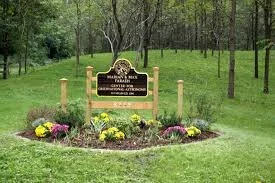
So that night I drove to Ionia. Once I got beyond Canandaigua, the roads narrowed and the traffic disappeared. Fields and farmhouses replaced shopping plazas and stoplights.
I drove past the observatory entrance before catching the small brown sign in the corner of my eye. The gravel road was narrow enough to look like a pathway.
The parking lot was a field that sat well below the observatory grounds. After parking, I walked up the hill.
I had expected one large observatory building with a dome. Instead, the property spread across a wooded hillside. Small observatory sheds were scattered among the trees and open fields. Some housed telescopes. Others contained specialized equipment. The main lodge was a simple white clapboard building.
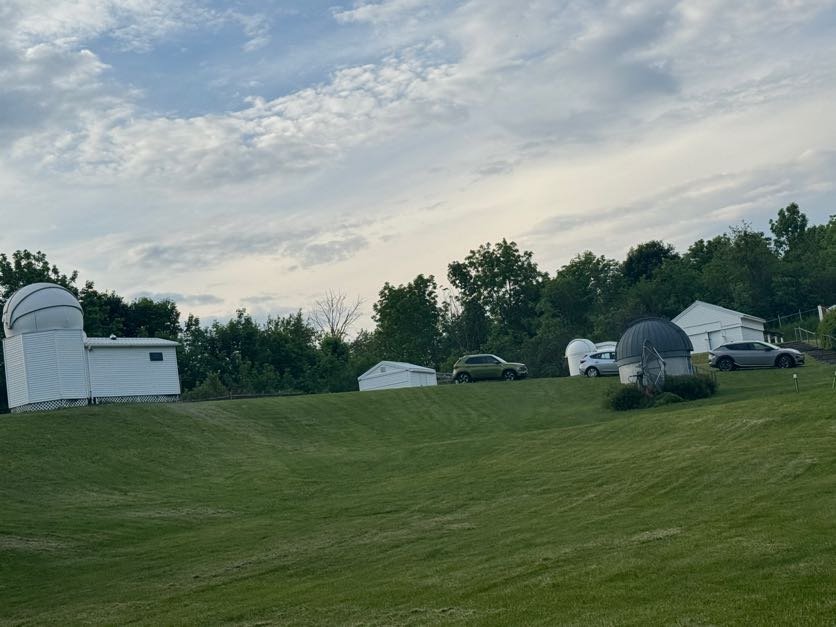
The Max Farash Observatory Grounds
Inside were a meeting room, kitchen, and restrooms. Tables, chairs, cabinets, bookshelves, and equipment filled the space. Nothing matched. Most of it appeared to have been donated or collected over the years. Nobody seemed concerned about the decor.
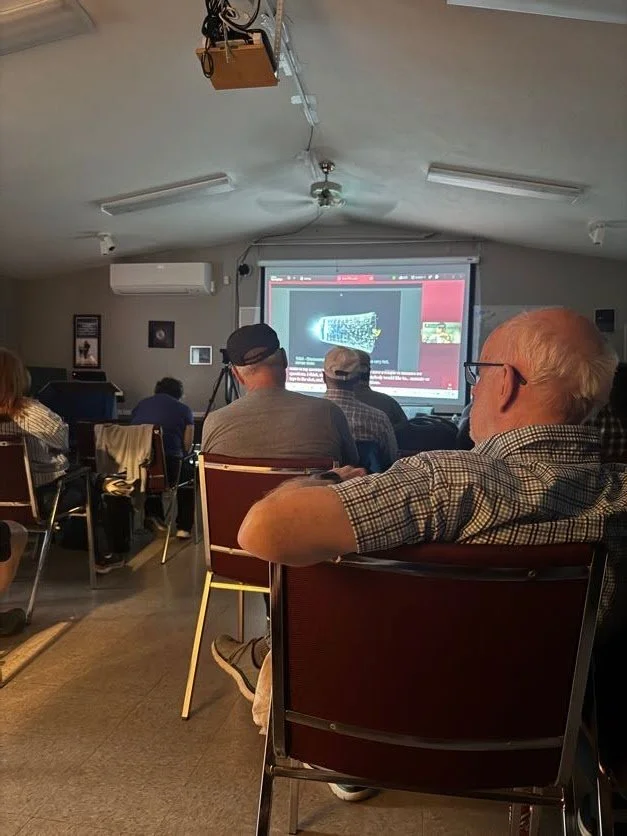
Attending the History of Cosmology Lecture
A vanilla sheet cake with white frosting sat on a table celebrating the club's 145th anniversary.
Above the front door was a large arc of house numbers arranged in a sequence I couldn't decipher. I never figured out what they meant and was too afraid to ask.
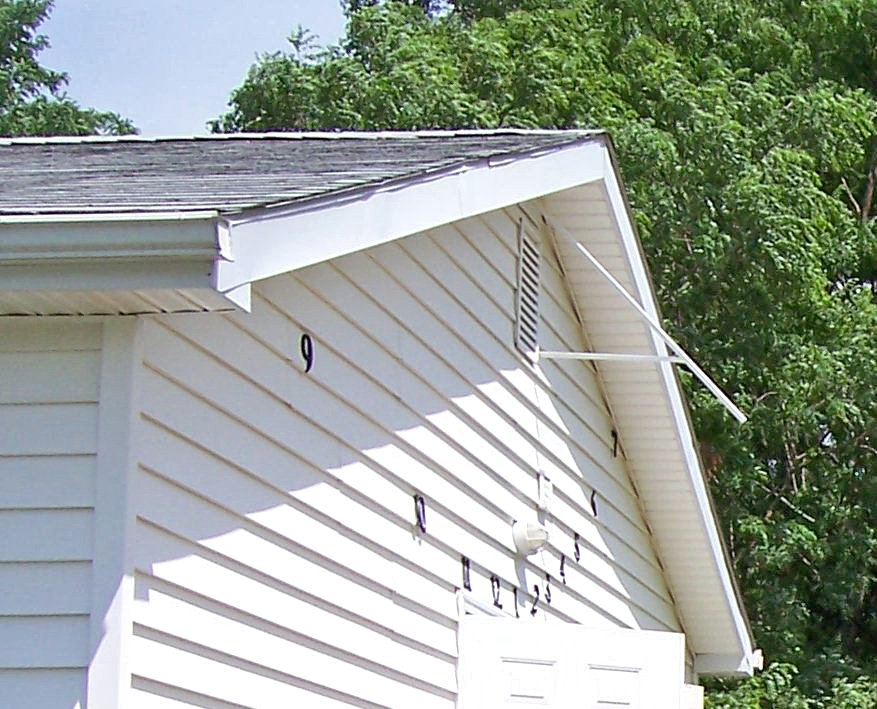
I later learned that the numbers on the lodge gable are a sundial.
People arrived carrying laptops, notebooks, and astronomy magazines. Several wore astronomy-themed clothing. One man had a Hawaiian-style shirt covered in planets. Another wore a golf shirt embroidered with tiny celestial objects. About thirty people attended in person. Others joined the zoom meeting remotely.
I sat with Jim, who I had spoken to earlier in the day, and his wife Margie.
Dave, a former club president, brought me down to the cluttered lodge basement and showed me all the Telescopes the club has available for loan to club members. Later, after the presentation, he gave me a tour of the site. He pointed out the telescope buildings and explained what they were used for. The telescopes ranged from roughly eight inches to sixteen inches in size. One setup was used for imaging. Another was equipped for spectroscopy. Dave explained that the property had once belonged to Max and Marion Farash, who donated the land. Another donor later provided the first telescope and observatory structure, and many more were added over time. Dave, told me about a recent membership survey. Of the 250 or so club members, the average has 2 Phds, and stated that the join the club for the chicken wings and socializing more than the science.
Dee, a friend of Jim and a club member for 20 years sat next to me for evening's presentation which was titled History of Cosmology. It lasted about an hour. There were a few struggles with the Zoom connection and audio, but nobody seemed particularly bothered by it. After the presentation, people drifted outside. The grounds contained fire pits surrounded by Adirondack chairs. A barbecue grill stood on the porch of the lodge.
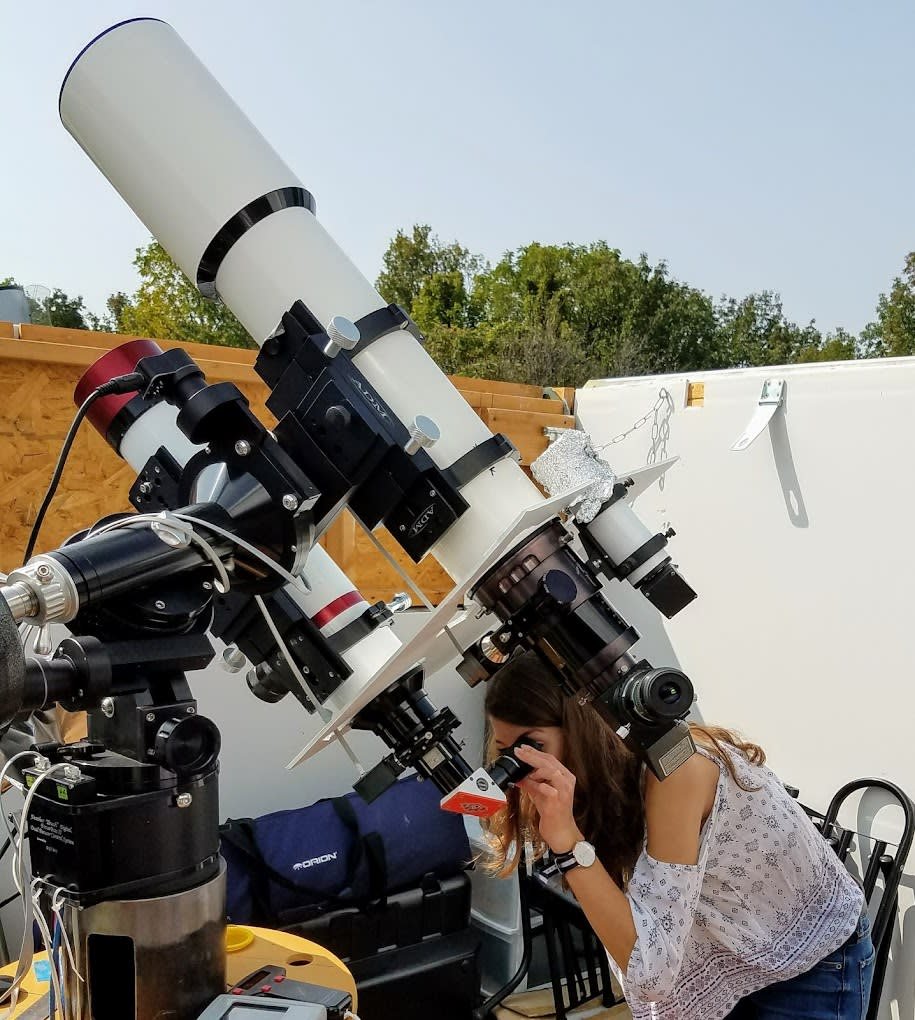
One of he Club Telescopes
The sky was mostly clear with only a few clouds. Venus was visible. Jupiter was visible. Members pointed out stars and constellations whose names I had never heard before. Two telescopes had been set up for viewing. When my turn came, I looked through the eyepiece at Jupiter. It appeared as a small beige-yellow disk crossed by rusty colored bands. Two tiny points of light floated nearby. I was told they were two of Jupiter's moons.
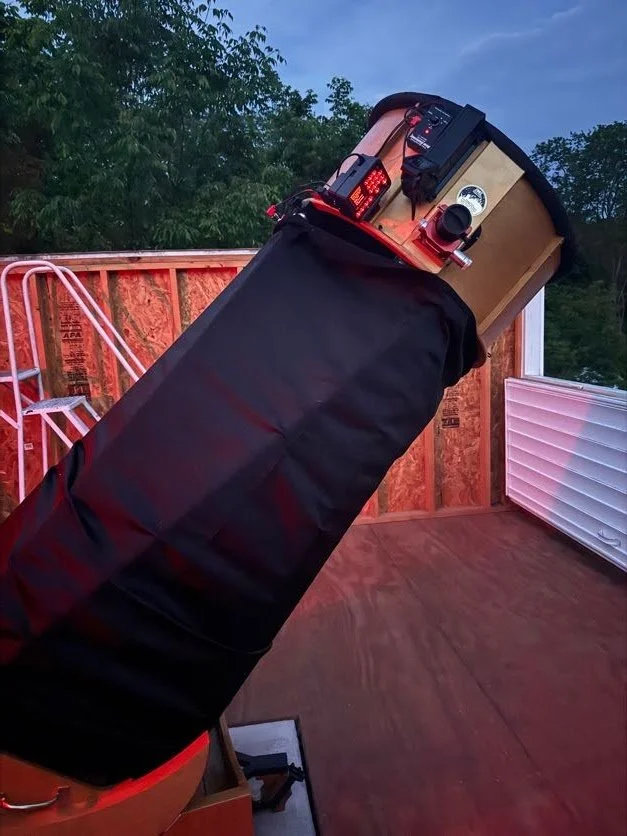
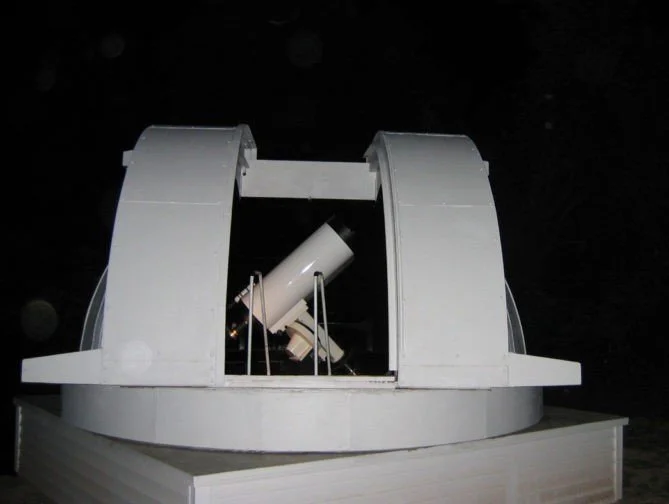
Conversations continued around the observatory buildings. Members discussed software, optics, telescope mounts, imaging equipment, observatories, and upcoming events. One software developer described astronomy programs he had written and distributed for free. Other members talked about engineering projects and equipment they were building or modifying.
When I asked how a beginner should learn astronomy, the answers varied. Some suggested learning the stars first. Others suggested finding a mentor and learning directly on the equipment. Dee suggested I join the club and find a mentor to help me learn as she had done. Dave insisted on giving me his email account, so I could ask him any questions.
By 10 PM, people were still arriving at telescopes, talking in small groups, and planning additional observing. A few discussed meeting later for drinks and snacks. I was among the earlier departures. The walk back to the car was longer than it had seemed on the way in. The path was dark enough that I had to watch the ground carefully, but someone had painted small glow-in-the-dark stars along the edge of the pathway out.
